

🧐 Overview
AI Call History is where you review past calls handled by your AI agents. You can:- See when each call happened, which agent was used, phone numbers, how long the call lasted, and how the call ended.
- Narrow the list using filters (dates, agent, duration, direction, and more).
- Open a single call to read the summary, full conversation text, and listen to the recording when one is available.
- Download the same filtered results as a file for your own records or reporting.
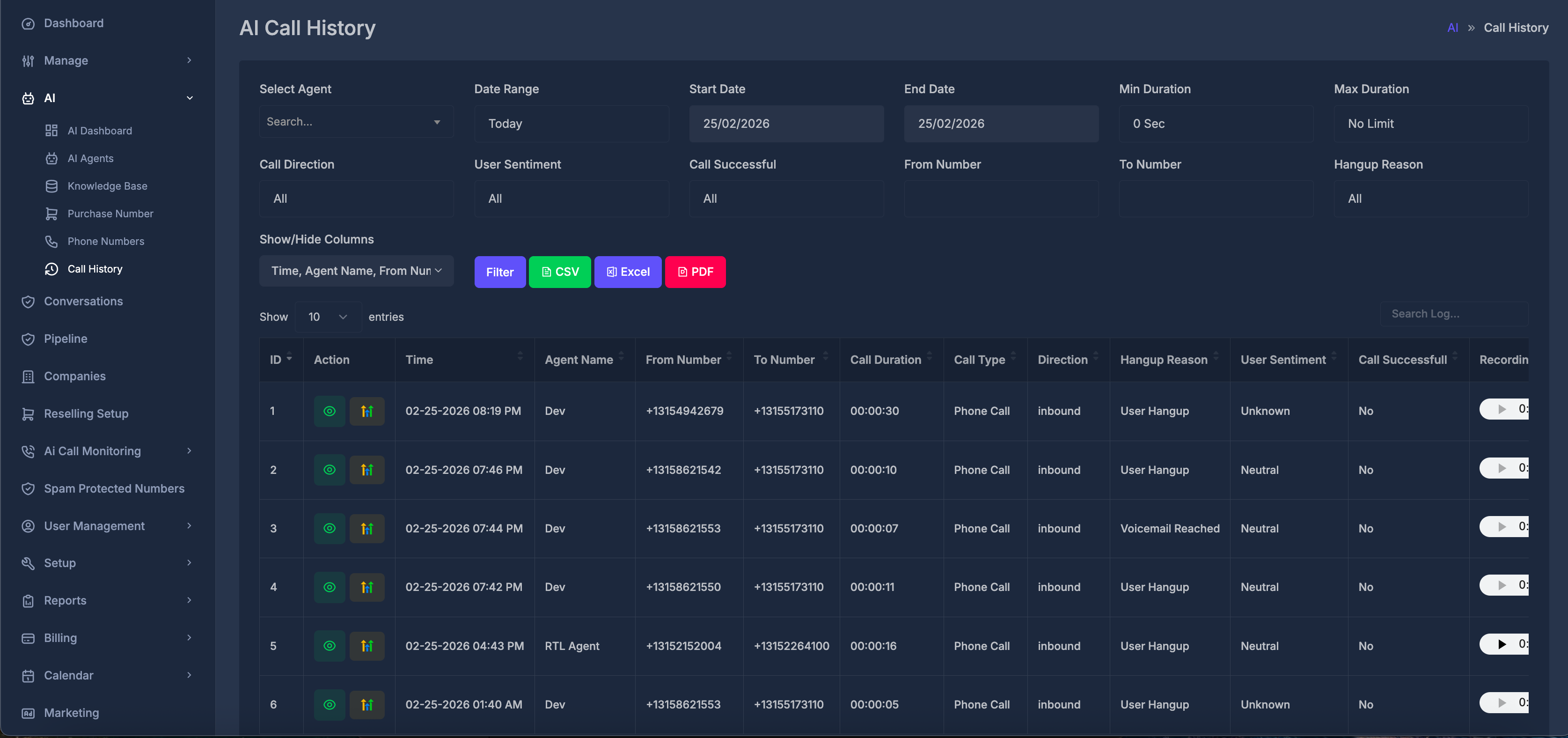
🔎 Filters
Filters work together: only calls that match all the conditions you set are shown. If you leave a filter on its default “everything” setting, it does not restrict results. 👤 Select Agent- Choose one AI agent to see only that agent’s calls, or leave the placeholder (empty) to see calls from all agents in your list.
- You can type in the box to search agent names when the list is long.
- Changing the agent refreshes the list .
When Custom dates is not selected, Start Date and End Date are filled automatically for you and cannot be edited (they stay in sync with the range you picked).
When the page first opens, Today is usually selected.
⏰ Start Date and End Date
- Used to define the beginning and end of the period you care about.
- Only active when Date Range is set to Custom dates; otherwise they follow the preset range and are read-only.
0 Sec means “no minimum” — calls of any length are allowed from this filter. ⏲️ Max Duration Shows only calls whose length is no longer than the time you pick.
No Limit means “no maximum” — this filter does not cut off longer calls. Min and Max can be used together to target a band (for example, between 30 seconds and 5 minutes). 🔄 Call Direction
😊 User Sentiment
Roughly how the conversation mood was classified:
✅ Call Successful
📞 From Number
Enter the caller’s phone number to show only calls from that number.
The value should match exactly how the number is stored (same digits and formatting as in your records). ☎️ To Number Enter the called phone number to show only calls to that number.
Again, match exactly as stored. 🔚 Hangup Reason Limits the list to calls that ended for a specific reason. All means every reason is allowed. The names on the screen are written in everyday language. Examples include:
- User Hangup — the person on the other end ended the call.
- Agent Hangup — the AI side ended the call.
- Call Transfer — the call was transferred elsewhere.
- Voicemail Reached — voicemail was detected or reached.
- Inactivity — the call ended because nothing happened for too long.
- Machine Detected — an answering machine or similar was detected.
- Max Duration Reached — the call hit a maximum allowed length.
- Concurrency Limit Reached — too many calls were active at once.
- No Valid Payment — payment-related validation failed.
- Scam Detected — flagged as scam-related.
- Marked As Spam — treated as spam.
- User Declined — the user refused or declined the call.
- Time
- Agent Name
- From Number
- To Number
- Call Duration
- Call Type
- Direction
- Hangup Reason
- User Sentiment
- Call Successful
- Recording
- Call Summary
- Call Transcript
🛠️ Action buttons
🔍 Filter Applies your current filter choices and reloads the list. Use it after changing dates, agent, or other fields (some fields also refresh the list when changed). 📄 CSV Downloads a simple text file that opens in Excel and most spreadsheet programs. The file name starts with AI_Call_History_ and includes a date and time stamp. 📊 Excel Downloads a spreadsheet file that opens in Microsoft Excel and similar apps. It includes a simple title and “generated on” line above the table. 📝 PDF Downloads a report file built as a printable layout. The file name starts with AI_Call_History_ and includes a date and time stamp. You can open the downloaded file with your usual apps for viewing or printing reports. While a download is running, the button you clicked may show a short “exporting” state and is temporarily disabled so you do not start duplicate downloads.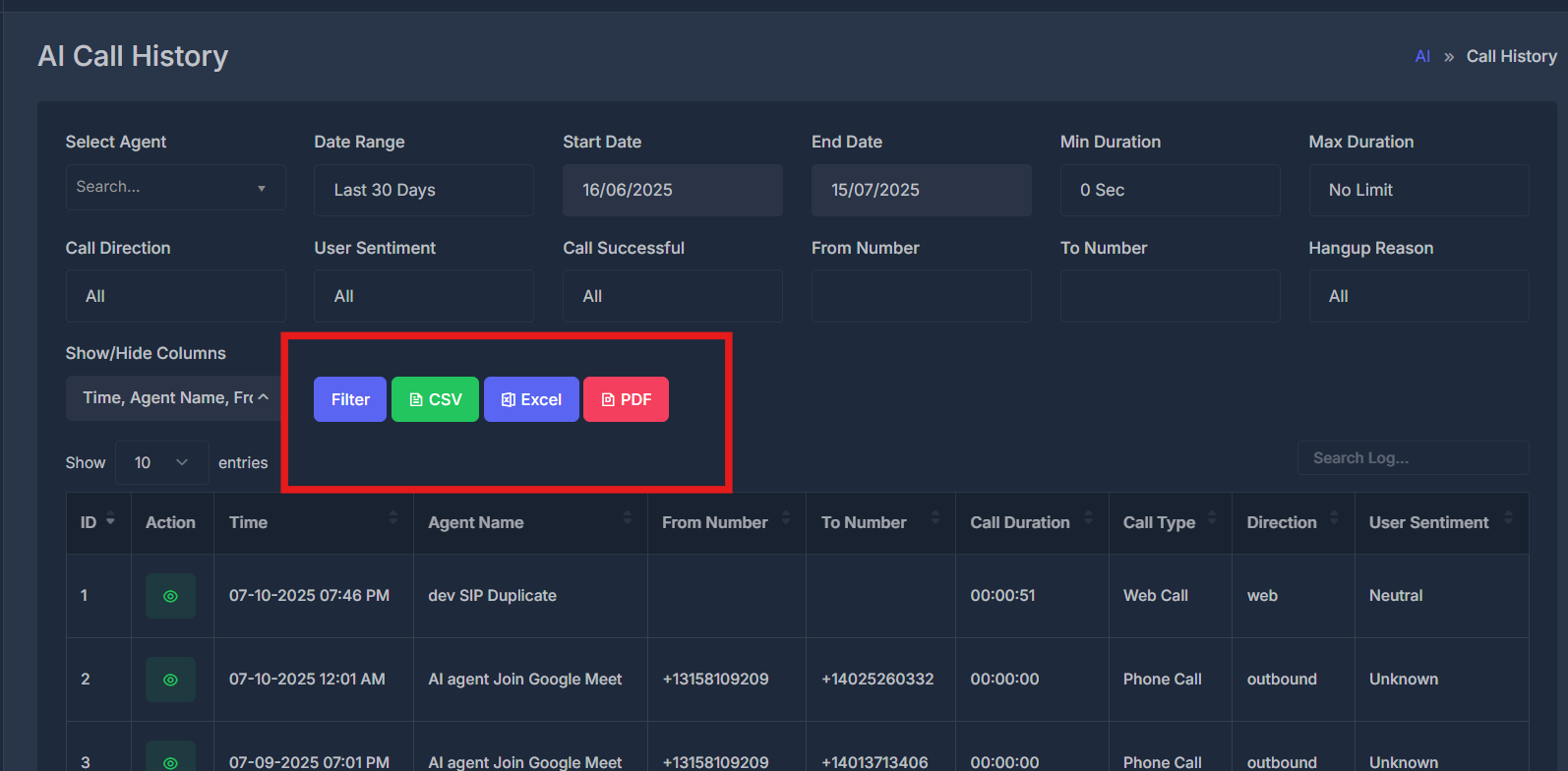
📋 The main list (table)
The table shows one row per call. By default, newer activity tends to appear toward the top (ordered by the row identifier).📑 Columns explained
🔎 Search Log
Above the table, the box labeled Search Log… lets you search within the loaded columns of the current result set (helpful for finding a number or word without changing the main filters).
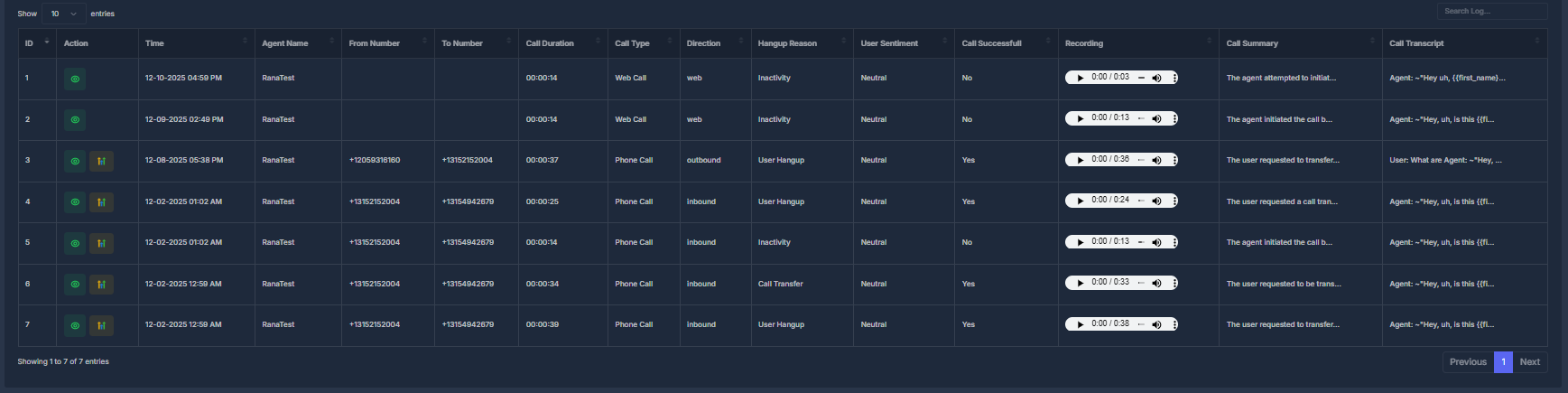
🗂️ Action column: what the buttons do
👁️ View (green, eye icon) Opens the call detail view for that row. Only people in your organization who are allowed to use this area can see these calls. 🚀 Go High Level (optional, logo button) If the call is linked to a contact in Go High Level and your agent is set up with the right location, a second button appears. It opens that contact’s page in Go High Level in a new browser tab so you can continue work there. If there is no link, only the eye button appears.📝 Call detail screen (after you click View)
The main list hides and a detail layout appears. Use Back to return to the list without losing your filters. 🔝 Top section- Title line — shows the date and time of the call (in your time zone).
- Agent — name of the AI agent.
- Duration — length of the call.
- Recording — audio player when a recording is available. If there is no recording URL, the player may still appear but have nothing to play.
- Call Successful — Yes/No (or stored value) as recorded for that call.
- Call Type — type of call.
- Disconnection Reason — raw reason the system stored for how the call ended (may match Hangup Reason in the list).
- Voicemail Detected — shows true when the disconnection reason indicates voicemail was reached; otherwise false.
📤 Exporting Your Call Data
When you export call history, the export file reflects exactly what you see in your filtered table—using all the same filters (like date, agent, call duration, direction, sentiment, success, phone numbers, and hangup reason). Each exported row will include:- A unique ID (per row, in order)
- Time (displayed in your time zone)
- Agent Name
- From Number and To Number
- Call Duration
- Call Type
- Direction (inbound/outbound)
- Hangup Reason
- User Sentiment
- Call Successful (yes/no)
- Call Summary (the complete summary, not just a snippet)
- Call Transcript (the full conversation, not just a preview)
Note: Audio recordings are not included in exported files. To listen to call recordings, use the main list or the detail screen.